





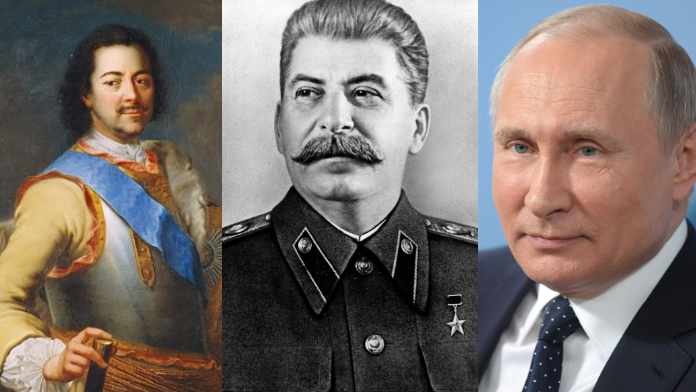
Marx was hostile to Russia and to Tsarism for their despotism, which crushed populations by stifling every political and social freedom, as well as for their unbridled, expansionist and highly aggressive imperialism: and on this he wrote repeatedly, even with an emotional fury that here and there seemed to verge on forms of creeping racism. But what makes this hatred and these writings, often furious, interesting and topical, at least in my eyes, is the fact that both appear motivated by the same reasons for which Stalin’s Russia deserved to be fought and opposed yesterday and Putin’s today, with a series of striking analogies that may suggest that a redivivus Marx would have reserved similar hostility towards the last century of Soviet-Russian dictatorial and imperialist policy
The analogies between Marx’s aversion to Tsarism and the current aversion to Putinism (and yesterday to Stalinism)
“Marx hated the arrogance with which Moscow threatened its neighbours and Europe. He hated it as a bastion of conservatism and authoritarianism, the sworn enemy of the peoples’ democratic and independence aspirations. He denounced its territorial ambitions towards its neighbours and its systematic interference in European politics in support of extreme reactionaries. He criticised with even excessive vehemence the weakness of the West in opposing Russian expansionism and the Russian threat. For him, the Tsarist empire was a veritable empire of Evil (Siegmund Ginzberg)”. The analogies and historical recurrences (that “return of the same”) that stretch a very robust “black thread”, moreover claimed by the protagonists themselves in power, between Tsarism, Stalinism and Putinism, cannot fail to strike and surprise even those not specialised in historical work. The fundamental texts in which Marx explained and motivated his decisive hostility towards Russia and Tsarism “despotic, oppressive, reactionary, expansionist and bellicose“, all his adjectives, are Revelations on the Diplomatic History of the Eighteenth Century (1856-1857) and the collection of articles The Eastern Question, published in the New York Daily Tribune between 1853 and 1856. In the first text, Marx offered a ruthless and extremely severe overview of Russian power, placing a colossal historical millstone on its genesis, considering it namely the result of a long “servile submission to Mongol domination“, from which the Tsars would have deduced and reproduced their own oppressive and expansionist methods of domination. Marx wrote in pages of fiery polemic: “Russia was born and formed in the muddy slavery of the Tatar yoke. It gathered its strength only by becoming a virtuoso in the art of submission… Even after being emancipated, Russia continued to play its traditional role of the slave who became master. Russian policy is immutable. Its methods, its tactics, its stratagems may change, but the polar star of its policy – world domination – is a fixed star“. And there was plenty of it, with severe relentlessness, especially for Peter the Great, Putin’s favourite Tsar and maximum model: “Peter the Great fused the political cunning of the Mongol slave with the fierce aspirations of the Mongol master, to whom Genghis Khan had left in his testament the conquest of the world“. Marx dedicated particular study to the strategies of Peter the Great and his will for world domination. He did so using the enormous collection of books, manuscripts and especially diplomatic correspondence that he was able to consult in the reading room of the British Museum – during the period of drafting the first volume of Capital: the material served him not only for political debate but also for the journalistic articles that gave him a living – and, particularly for the subject we are dealing with, he made good use of the dispatches of British ambassadors to the court of St. Petersburg, during Peter the Great’s rule over Russia.
Specifically, Marx saw, for example, in Peter the Great’s choice to move the Russian capital from Moscow to St. Petersburg in 1712, the symbol of a grand design of world conquest. “St. Petersburg is the window from which Russia can gaze over the whole of Europe“. Marx believed that Peter the Great intended to change the external appearance of what Marx considered the maximum form, together with the Chinese and Turkish empires, of the “Asian despotism” typical of societies (also defined by him as “Eastern hydraulic“) founded on a gigantic bureaucratic caste and on the semi-slave labour of tens (or hundreds) of millions of individuals who lived in the deepest misery and submission. Marx judged Tsar Peter to be maximally aggressive and oppressive, all the more so because he intended to “modernise” and “Europeanise” Russia not to make his people better off but to transform Great Russia into the greatest power of the Baltic, that is, “Russifying Europe, while Russia Europeanises itself“.
“One thing Peter the Great did well: attracting manpower, especially foreign brains. Paying them well and treating them with less contempt than Stalin treated his Communist International, manipulating it for Russia’s exclusive interest. Catherine II had won over the best of Europe’s Enlightenment intelligentsia, people of the calibre of Voltaire and Diderot. It was a Neapolitan who conquered Crimea for her and built Odessa for her. In seizing the Baltic provinces, Tsar Peter immediately seized what he needed… With an iron fist against dissent at home, intimidating allies and neighbouring states, using Western technology and know-how unscrupulously, diplomacy, unconfessed complicity. (Siegmund Ginzberg)”. A “merit” that Marx did not fail to recognise, while warning of the extreme danger for Europe and the entire world of such actions, writing: “The Baltic provinces gave him not only diplomats and generals, the brains with which to exercise his political and military action on the West, but also a host of bureaucrats, teachers, instructors who trained the Russians in a semblance of civilisation that allowed them to use the tools of Western technology, without however impregnating them with its ideas.”
There is no wonder that the harshness of the aversion to Tsarist Russian imperialism and its internal dictatorship, thus reproduced, mutatis mutandis, by Stalin’s Soviet Union, induced Stalin himself – who moreover admired imperialist and aggressive Tsarism and the founding idea of Great Mother Russia, even if his sympathies, rather than for Peter the Great, were directed towards the sixteenth-century Ivan the Terrible – to impose censorship and cancellation of these works, and especially of the Revelations on the Diplomatic History of the 18th Century, from the complete Soviet editions of the works of Marx and Engels: even the most politically unaware citizen would have found the analogies between the Tsarism denounced by Marx and Stalinism glaring; and, given the formal and hagiographic exaltation of Marxism, then operated daily in the USSR, the contrast between “preaching” and reality would have been glaring. Such censorship, obviously no longer necessary for Putinism, which stopped speaking of Marxism from its first “coronation”, let alone proposing the complete works of Marx and Engels in propaganda: but there is no doubt that in that “attracting foreign brains, paying and treating them well, manipulating them for Russia’s exclusive interest… winning over the best of Europe’s intelligentsia, with an iron fist against dissent at home, intimidating allies and neighbouring states, using Western technology and know-how unscrupulously, diplomacy, unconfessed complicity” one also sees the multi-decade face of Putinism. That mixing of ferocity against internal dissent, and the direct, physical elimination of opponents, with blandishments towards European intellectuals, of the “left” and right, manipulating them, using them for the exclusive interest of the Russian power and the renewed neo-Tsarist attempt to remake Great Russia, threatening and invading neighbouring states, using the most advanced technologies, IT and communications, of the West against the West itself, abundantly “infiltrated” with a multifaceted and unscrupulous propaganda.
On the terrain of analogies between the decidedly hostile description that Marx gives of Tsarist Russia and the operations of Stalinist Russia and even more of Putin’s Russia, the observation, almost admiring, that Marx gives to the Tsarist ability to found its power on a mutually advantageous alliance with the Russian Orthodox Church, for example, leaps to the eye: exactly the same operation carried out successfully by Putin, where the “pope” Kirill has played a leading role in the multi-decade support for the regime, before and especially after the invasion of Ukraine, and of the alleged “irredentism” of the Russian-speaking regions over the last five years. Similarly, the parallel between the current struggle of the Ukrainian people against the Putinist invader and that of the Polish nationalists (which we will analyse later) against Tsarist despotism and imperialism, strongly supported and exalted by Marx, who was convinced that, in addition to the expansionism of territorial conquest towards Europe, Tsarism also intended to play a reactionary role against the revolutionary or in any case reformist and democratic processes underway or in fieri on the continent, stands out.
The parallels between the Russian aggression against Crimea and Turkey (1853) and the current one against Ukraine
On this latter point, the analogy becomes even more fitting if one analyses the very clear position taken by Marx and Engels regarding the Crimean War, which saw them condemn with the utmost vigour the Russian aggression against the Danubian Principalities, Crimea and Turkey, even supporting the necessity of armed intervention in the conflict by the main European powers alongside Turkey, although vilified by them as a reactionary, despotic and imperialist country equal to Russia. It is worth recalling how in the period (the 1840s and 1850s) of maximum European expansion and power of Russia, viewed with great concern by the other European powers and especially by France and Great Britain, the outbreak of the Crimean War matured between the Russian Empire, on one side, and the Ottoman Empire, supported, a few months after the outbreak of the conflict, by France, England and, subsequently, even by a military contingent from the Kingdom of Sardinia. The casus belli was Tsar Nicholas I’s claim to impose a Russian protectorate over all Russian-speaking populations and/or Christian-Orthodox populations belonging to the Ottoman Empire (doesn’t this recall a similar Putinist claim to impose similar diktats on the independent Ukrainian state, and in particular a similar “protectorate” over the Russian-speaking Ukrainian populations?). Faced with the Turkish refusal, supported moreover by a France greatly concerned about Tsarist expansionism towards the Mediterranean, Nicholas I effectively declared war on Turkey, invading in October 1853 with a powerful army the Danubian Principalities of Moldavia and Wallachia, vassals of the Ottoman Empire, emboldened by the fact that he had found no resistance there (the Turkish army retreated without fighting). But the climate, apparently favourable to Russia (similar to that of the first weeks of Putin’s invasion of Ukraine, right?), changed rapidly: Turkey formally entered the war on 4 October, joined in March 1854 by France and Great Britain (the Kingdom of Sardinia sent its contingent in January 1855). The epicentre of the war was the Russian peninsula of Crimea and in particular the city of Sevastopol, the main Russian naval base in the Black Sea, besieged by the joint French, British and Turkish fleets. In September 1855 the Russian troops abandoned the city, marking the defeat of Tsarist imperialist aggression, which was apparently sanctioned by the Treaty of Paris of February 1856, which caused Russia’s withdrawal from the Danubian Principalities, taken from the Turks during the invasion, which unified to create a new state, Romania.
Ginzberg highlighted two other analogies with the current war in Ukraine: the will to impose a blitzkrieg and the endless negotiations to avoid or interrupt the war, with similar unsuccessful results: “In intention, the Crimean War was supposed to be short. And instead it dragged on for years with alternating fortunes on the field… The troops were decimated in the trenches, in endless sieges like that of Sevastopol, the civilian population in bombings and looting. Finally, after unspeakable suffering, back to square one. Even more striking are the analogies (n.d.s. with the war in Ukraine) for the very long diplomatic work that sought to avoid the conflict. Then, the negotiations continued uninterruptedly during the war with manoeuvres, twists, cunning, stalling that would make the endless negotiations on the Middle East and Ukraine envious… Every time it seemed they were about to agree, an already agreed point was reopened, with proposals and counter-proposals even after the war ended. The Peace Treaty of Paris held for the space of a morning: also because, as the French plenipotentiary Adolphe de Bourqueney observed, reading the treaty it was impossible to determine who had won.”
Against the aggression, as already mentioned, Marx and Engels used drastically critical words, despite their repeatedly expressed hostility towards Turkey and the Ottoman Empire. The whole matter is dealt with in the already cited The Eastern Question, a collection of 113 articles that Marx, sometimes in collaboration with Engels, wrote between 1853 and 1856 for the New York Daily Tribune (at the time the most widely circulated newspaper in the world, for which Marx was the London correspondent), which was published posthumously by his daughter Eleanor. Here are some passages of the violent polemic of the two against the Tsarist aggression, expressed immediately after the Russian invasion of the Danubian Principalities and traceable, more extensively and in complete form, especially in the articles The Real Turkish Question (April 1853), The Russian Threat to Europe (April ’53), The Russian Fraud (June ’53), Russian Policy against Turkey (July ’53), The Conduct of Russia (December ’53): “In this whole affair, the conduct of Russia has been that of a bully. Menshikov’s appearances and behaviour at Constantinople were those of a bully, Nesselrode’s manifestos were the threats of a bully; and the entry of troops into the Principalities was nothing but the bold presumption of a bully (from the article Russian Policy, 30 December 1853, published by the NYDT)” (n.d.s. Aleksandr Menshikov was the commander-in-chief of the Russian invasion troops; Karl Vasilevic Nesselrode was Foreign Minister and Chancellor of Nicholas I, author of propaganda and anti-Turkish foreign policy). How not to think of similar bullying behaviour, at the time of the invasion of Ukraine, by Putin, Medvedev, Lavrov and company regarding the alleged unstoppability of the “blitzkrieg”, hypocritically defined as a “special military operation”, and the grandiose proclamations that guaranteed the closure of the affair in a few days?
And again, still from the Tribune articles: “No man with a grain of intelligence can fail to understand that Russia is a conquering country, that it has been so for centuries, until it was stopped by the revolution of 1789.” Or also: “This spirit of annexation and aggrandisement only needs to show itself in its true form to excite a universal antipathy and an insurmountable opposition, in which the very Greek and Slav subjects of Turkey are ready to take a great part.” Whereas, continuing the parallel with today in Ukraine, one must acknowledge Putin and the Putinists’ far greater skill not only in avoiding “universal antipathy” but, indeed, in developing an intense propaganda capable of obtaining widespread sympathy even in unsuspected “Western” circles. Or, finally, this time signed by Engels, again from the Tribune: “Russia is decidedly a conquering nation. If we allow Russia to seize Turkey, it would become superior to the rest of Europe put together. Such an event would represent an unspeakable calamity for the revolutionary cause. The interests of democracy and England in this case coincide. Neither the one nor the other can allow the Tsar to make Constantinople one of his capitals.” Obviously for today’s Ukraine, the “revolutionary cause” is not at stake, but certainly the decisive brake on Russian imperialist expansionism posed by the incredible and innovative combativeness of the Ukrainian people is.
The support of Marx and Engels for the Polish people’s struggle for independence from Russia
More or less in the period of these writings, and in the immediately following years, Marx attacked the Tsarist empire just as virulently for another misdeed, even more serious than the military aggression against the Principalities and Turkey: the progressive total “Russification” of Poland, that is, the cancellation of its political, legal, cultural and religious identity and its complete assimilation, as if it were a province, into Imperial Russia. At least the main stages of the annihilation of Polish national identity should be remembered, which – starting from the defeat of the armed revolt against Russian rule (November 1830) with the insurrection of some units of Polish cadets (hence the name “cadet revolt”) of the Russian imperial army – was accelerated year after year: at the beginning of 1832 the abolition of the Polish Constitution, two years later the dissolution of Parliament and the armed forces and the deportation of tens of thousands of Polish opponents to Siberia (a “tradition” kept alive, and indeed abundantly relaunched, by Stalin, and also recovered by Putin, albeit with certainly smaller numbers); in 1833 introduction of Martial Law, in 1839 dissolution of the Catholic Churches (of the Eastern rite) and forced conversion of the clergy, Churches and faithful to the Russian Orthodox Church; in 1841 abolition of Polish currency and imposition of Russian currency, in 1847 the Polish legal code was also cancelled and replaced by the Russian one; then, after the umpteenth failed Polish revolt (1863-1864), in 1869 the imposition of Russian as the official language in public, administrative, legal acts, but also in teaching; and from there, until the outbreak of the First World War, a succession of extraordinary laws to eliminate every trace of autonomy of Poland and its population.
During this outrage, Marx and Engels repeatedly demonstrated that they considered Poland a sort of “democratic shield” for all of Europe against Great Russian despotism and imperialism, stating for example: “There is only one alternative for Europe: either Asian barbarism, under Muscovite leadership, will descend like an avalanche upon civilisation, or Europe must restore Poland, thus placing between itself and Asia, twenty million heroes (from the Discourse on Poland, London, 22 January 1867)”. Thus, returning to the analogies with the Stalinist and post-Stalinist era of the Soviet Union and the current reality of Putin’s Russia, the annihilation of Polish autonomy and identity cannot but appear very similar to the Soviet “Russification” of Eastern Europe and the subsequent crushing of the Hungarian revolt (1956) and Czechoslovak independence (1968), as well as the 1981 coup, organised by Moscow, by Jaruzelski in Poland. But a powerful reference also seems to the fate that, in all likelihood, would have befallen Ukraine if the Russian blitzkrieg had succeeded, taking into account Putin’s repeated neo-Tsarist statements on Ukraine’s non-existence as a nation, state and independent population. A few days before the Russian army invaded Ukraine, Putin in a televised speech argued that Ukraine had no right to be considered a nation and an independent country, as it was an “artificial creation of Vladimir Lenin“:* * verbatim, “Soviet Ukraine is the result of Bolshevik policy and can legitimately be called Vladimir Lenin’s Ukraine“. According to Serhii Plokhy, professor of Ukrainian History at Harvard University, where he is also Director of the Ukrainian Research Institute, “Putin’s argument about Lenin draws on a Russian nationalism that predates 1917, a nationalism that condemned Lenin for recognising the rights of Ukrainians, Georgians and Armenians within the Soviet structure. Russian imperialism is the lens through which Putin looks at the world, like Tsar Nicholas II.”
Ukraine has broken the continuity of Russian aggressions: a just peace can only be achieved by rebalancing the forces in the field
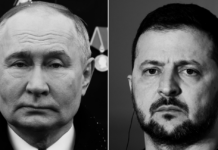
There is, however, within these analogies, an element of strong discontinuity: the incredible, surprising, unexpected capacity of the Ukrainian people to do what neither 19th-century Poland, despite similar popular heroism, nor the Hungarians in 1956 or the Czechoslovaks in 1968 or the Poles of Solidarity unfortunately managed to achieve: that is, to fight on equal terms and prevent Russian imperialism, first Tsarist and then Soviet, from prevailing. On this subject, I wrote some time ago, taking inspiration from Zelensky’s famous letter to Putin (cf. Ukraine: who is losing the war? 14 June 2026, in [www.pierobernocchi.it]):
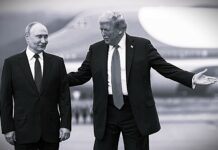
“Zelensky’s letter is pervaded by sarcasm towards Putin, but also towards those who considered the heroic resistance of the Ukrainian people hopeless: it testifies to the Ukrainian government’s full awareness of the enormous progress made against the criminal Russian invasion, after almost five years from that ‘special operation’ in the face of which the pacifist opinion (the sincere one, not the Putinist ‘pacifinta’), widespread in Italy, considered useless any attempt to stop the invading army, inviting, in the name of an irenic ‘one-dimensional pacifism’, the Ukrainians to lay down their arms and accept the surrender of their country to Russian despotism. And yet the Ukrainian people have performed unexpected miracles, changing the balance of power, inventing original, innovative and low-cost military equipment (with long-range drones costing less than a racing bike) that allows – even without the help of the solipsist US president, always seeking an understanding with the Russian neo-Tsar and repeatedly mocked by him – not only to defend their territory, albeit at the cost of many human losses and immense destruction, but even to strike deep into the Russian heartland, as far as Moscow and Leningrad, throwing Putin into panic even on the day of the annual military parade… Decades seem to have passed since Trump and his crony Vance cowardly laid an ambush for Zelensky at the White House, insulted and humiliated him live on television, and with him derided all Ukrainian citizens, resisters and fighters. Today Zelensky takes the best revenge, underlining not only Ukraine’s independence from the treacherous ex-US ally but also the impotence and wishful thinking of Trump who had childishly boasted he could ‘end the war in 24 hours’, now bogged down in Iran after a destructive as much as bungled aggression, which has given strength back to the horrid theocratic regime and nullified the heroic efforts to liberate the Iranian people.”
Moreover, the Ukrainian leadership has repeatedly claimed its increasingly advanced independence even from other military support, primarily European, wanting to signal how much it is now the European Union that needs Ukraine to counter Russian expansionism rather than the contrary, Ukraine being the one blocking, at least in Europe, the imperial ambitions of the neo-Tsar: and how much, indeed, it is the Russians who have had extreme need of military and economic intervention from their allies, to whom they appear increasingly subordinate, particularly with the intervention in the war alongside Russia of various units of the North Korean army, which has given an extra-European configuration to a war that the Putinists defined as “defence against European expansionism” (a bit, again regarding analogies between the eras of Russian imperialism, like the use of Cossack “atmans” in the Crimean War). Zelensky wrote on the subject: “Many did not believe that Ukraine would manage to resist this long. Yet, here we all are in the fifth year of war: Ukraine has preserved its independence and will preserve it, despite all contrary predictions. We have united many in the world on our side and against Russia. We found the weapons and the funding. We endured very harsh winters, while you (n.d.s. Putin) tried to destroy our energy system. We held on even in the darkness, our tenacity remained intact. We brought the war into your territory, and you would not have managed it without the help of North Korea. You are the first leader of Russia to turn to Pyongyang for assistance, and today you are completely dependent on China: this is also a first in Russian history.”
And at the same time, to sweep away the absurd and instrumental pro-Putin thesis of the “proxy conflict” – that is, a war that the Ukrainian people would have decided to fight, bearing all the sacrifices, mourning and destruction, at the request and on behalf of the United States – it was Trump himself who took care of it, also abandoning military support and openly rooting for Putin, in a framework of “armed partition” of areas of the world and of Ukraine itself. While the extraordinary Ukrainian combativeness has allowed, at least for those who evaluate in good faith, to dissect the true reasons for the war, which stem from Putin’s will to relaunch Russian imperialism and its expansionism, already verified in various other world chessboards, from the Maghreb to the Middle East, from Africa to Latin America. But with a particular and primary motivation regarding Ukraine, readable from when, as previously mentioned, Putin declared Ukraine a “non-existent” nation and state or, more precisely, a nation “invented” and artificially imposed by Lenin and the Bolsheviks. And it is precisely this that appeared and still appears intolerable to the Russian leadership: the fact that a “non-nation”, “Lenin’s Ukraine”, considered the heart of historical Russia, could and can pass to the West, sever all ties with the former “motherland” and act as a deadly attraction for that large part of the Russian people who, since the fall of the USSR, would have very willingly gone West.